
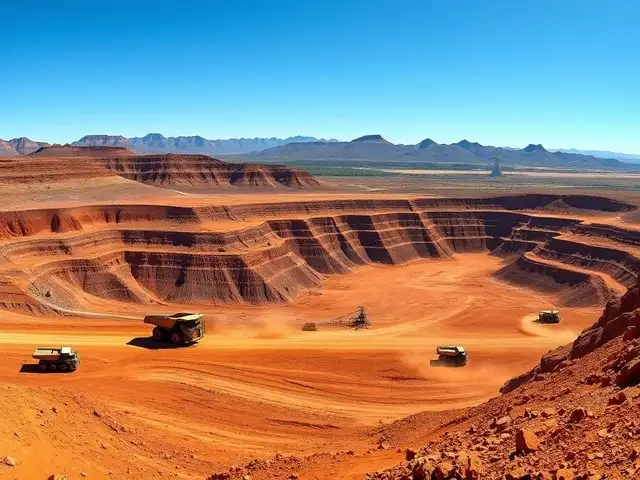
Iron Empire: Australia’s $6T Discovery
Western Australia has made global headlines with the discovery of the world’s largest known iron ore reserve, estimated at a staggering 55 billion metric tons. This massive deposit, located in the Hamersley region, holds a market value of approximately $6 trillion, and is poised to significantly strengthen Australia’s position as the world’s top iron ore exporter.
The discovery is not only vast in size but also remarkable in quality. Initial assessments report that the iron concentration exceeds 60%, making it exceptionally valuable for industrial applications. While the Hamersley region has long been recognized for its mineral wealth, this newly identified deposit reveals an extent of resources previously unknown.
This breakthrough was made possible by advancements in geological surveying and mining technology. Techniques such as remote sensing, deep drilling, and 3D subsurface mapping enabled researchers to identify and evaluate the full scale of the reserve with unprecedented accuracy.
Dr. Liam Courtney-Davies, a leading geologist from Curtin University and co-author of the study published in the Proceedings of the National Academy of Sciences, called the discovery a “radical transformation” for the mining sector. According to Dr. Davies, the size and purity of the deposit could significantly influence global iron ore prices and alter trade relationships, particularly with major steel producers like China.
Currently, Australia is the largest exporter of iron ore. This find further consolidates that position and opens the door to long-term supply security for international buyers. Industry analysts believe the deposit’s estimated $6 trillion value could attract massive foreign and domestic investment, potentially transforming the mining landscape of Western Australia.
The region is expected to undergo rapid development, including new transport infrastructure, processing facilities, and port expansions, all aimed at supporting increased mining activity. Experts predict this will boost employment, drive regional growth, and provide long-term economic benefits to the country.
However, alongside this economic optimism, environmental concerns are likely to become part of the broader conversation. As the project advances, stakeholders will need to balance the financial opportunity with environmental responsibility and community impact.
The discovery also has implications for the global mining industry, especially for countries dependent on imported high-grade iron ore. It raises strategic questions about how competing nations will respond, both economically and geopolitically.
In the coming months, more information is expected from mining companies and government agencies regarding project timelines, environmental studies, and infrastructure development. All eyes are now on how Australia plans to capitalize on what many are calling a once-in-a-century mining discovery.
In summary, this monumental find could reshape global supply chains, enhance Australia’s economic dominance in the sector, and mark a new era for the iron and steel industries worldwide.